

Now Reading: Europe’s Push for Tech Sovereignty Takes Centre Stage at G7, VivaTech
- 01
Europe’s Push for Tech Sovereignty Takes Centre Stage at G7, VivaTech

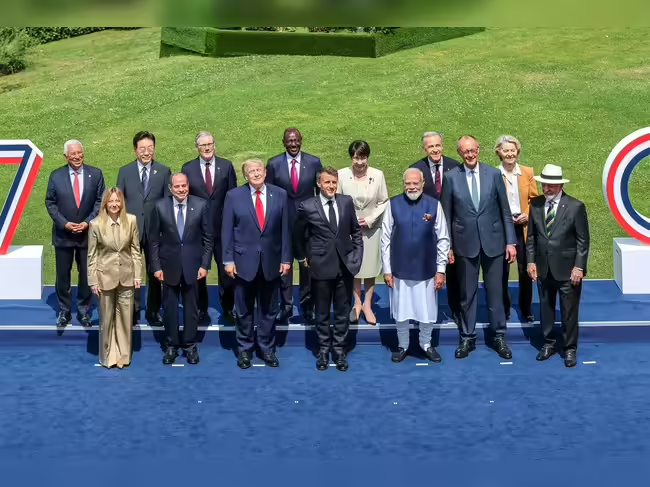
PARIS — Europe’s drive to reduce dependence on U.S. technology companies is expected to dominate discussions at the G7 summit and the VivaTech conference this week, as policymakers and industry leaders grapple with growing concerns over artificial intelligence, cloud infrastructure and digital sovereignty.
The debate has gained urgency following new U.S. restrictions on access to some of Anthropic’s most advanced AI models for foreign nationals, highlighting Europe’s reliance on American technology and raising fears that geopolitical decisions could disrupt the continent’s ambitions to build domestic AI champions.
“Tech sovereignty will be top of mind this week at VivaTech,” Ana Paula Assis, senior vice president at IBM, said. “For European organisations to get this right, it is vital to understand sovereignty is about having control where it matters — not where the technology is from.”
Leaders of the Group of Seven nations are meeting in Evian, France, alongside executives from major AI firms including OpenAI, Anthropic, Google’s parent company Alphabet and French startup Mistral. Discussions are expected to focus on AI competitiveness, regulation and supply-chain dependencies, including reliance on China for critical minerals.
Meanwhile, Paris is hosting the VivaTech technology conference, which organisers expect will attract more than 180,000 visitors, including startup founders, investors, policymakers and technology executives. Amazon founder Jeff Bezos is among the high-profile attendees.
The gatherings come as Europe seeks to balance strategic autonomy with continued dependence on U.S. firms that dominate key sectors such as cloud computing, semiconductor design and advanced AI research.
French AI company Mistral, widely regarded as Europe’s leading contender in the global AI race, is expanding partnerships with European businesses, particularly in sectors where regional policymakers believe Europe retains competitive advantages.
Despite billions of euros invested in AI development, European companies continue to rely heavily on American-owned cloud platforms, advanced semiconductors and foundational AI models.
EUROPE SEEKS GREATER CONTROL OVER DIGITAL INFRASTRUCTURE
France has emerged as one of the strongest advocates for European technological sovereignty, with the government increasingly promoting domestic and regional alternatives to U.S.-based digital services.
“We cannot rely on tools developed by foreign powers. France must have its own tools,” Prime Minister Sebastien Lecornu said on Tuesday.
The European Commission is also assessing the implications of recent U.S. export-control measures and has stressed that restrictions should not unfairly affect allied nations.
European policymakers have increasingly framed AI development as both an economic and national security priority. The European Commission recently unveiled plans to establish AI “gigafactories” and large-scale computing infrastructure aimed at securing independent access to computing power across the bloc.
Brussels has also proposed legislation designed to strengthen Europe’s cloud, artificial intelligence and semiconductor industries, though analysts say the region remains significantly behind the United States and parts of Asia in several critical technologies.
“It is patently clear, if it wasn’t before, how important it is for Europe to have access to an AI service that it can control, that will never be switched off on a whim,” telecommunications company Orange said in a statement.
Industry executives caution, however, that greater technological independence carries substantial costs. Karine Brunet, chief operating officer of Capgemini, said European cloud alternatives can cost up to 40% more than competing services.
For many companies, the challenge is finding a balance between resilience and affordability.
“The alternative is not simply replacing one provider with another,” said Francois Bitouzet, managing director of VivaTech. “It is about building more resilient technology strategies, where companies can draw on European innovation for the most critical parts of their stack while still working with global partners where it makes sense.”
Also Read: Taiwan Launches Intelligence Portal for Chinese Citizens to Report on Beijing

A Lagos-based journalist with a passion for disseminating factual information and a deep appreciation for good music, good food, movies, and beautiful cars. He hopes to travel the world someday, documenting its beauty and diverse cultures through his storytelling.
Stay Informed With the Latest & Most Important News
Previous Post
Next Post